
EJAlbum & Fotopasion Magazine
This article on our blog is a tribute to a rather interesting and fruitful collaboration we have had over these two years with this magazine and these young people passionate about photography. EJAlbum was born from a passion for photography, exactly like Fotopasion. This was the third issue of our collaboration, and our wish is always that photography's "devotees" keep growing in Albania — from EJAlbum there will always be support for such initiatives.
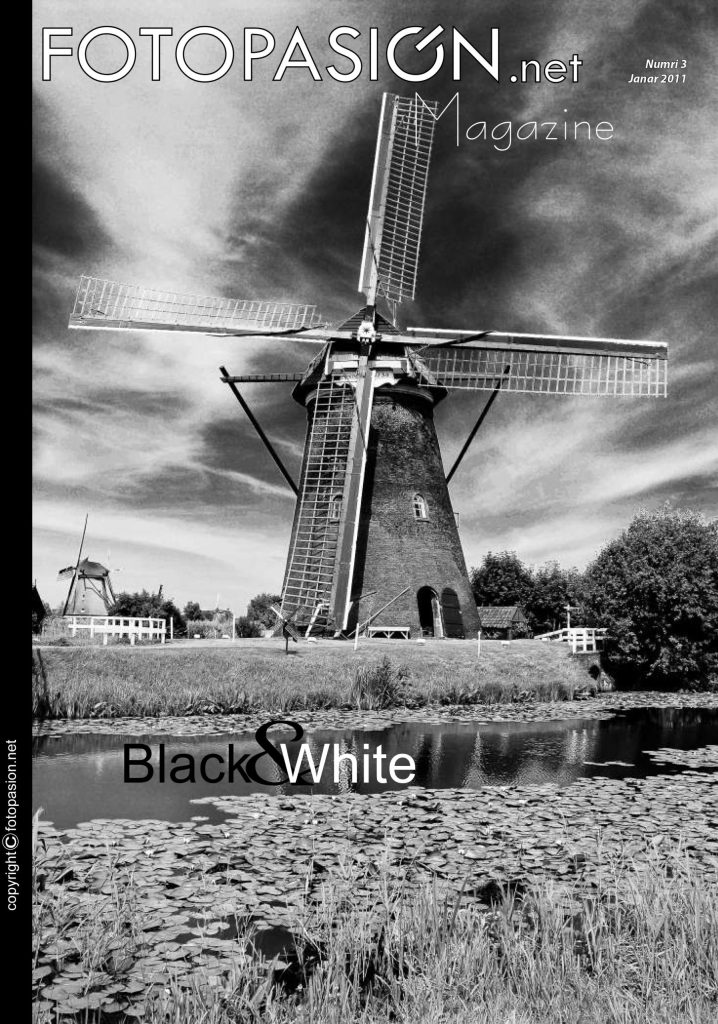
"A word of greeting…" – Julinda Mbrica. EJAlbum PR
This issue's theme for the magazine was a very good opportunity to uncover the traces that more than a century of photography has left deep within us. Because this art is born in black and white. In fact, many photographers, despite all the possibilities of colour film, never "betrayed" that black and white.
Gabriele Basilico has used it his whole life in architecture, or rather in what he calls "Urban Landscape." Gianni Berengo Gardin, like almost all the photographers of "Magnum," have built a cult around this kind of photography for documenting, or in Gardin's case, better to say "interpreting," everyday reality. Countless are the photographers who, throughout their entire careers, use only this type of photography. We ourselves have the photos of our own family members in our albums mostly in black and white.
If we refer to the theory of light, even colours are simply an "interpretation" by the brain of light's reflection; in truth they don't exist. This is why we at EJAlbum expected a great deal from photographers this time. Unfortunately we have to admit that very few took it seriously, and the photographs are very few. In any case, as always, we thank the participants for their courage, because black-and-white photography is difficult given its historical weight and the challenge it carries within it.
To judge something carries within it all of one's subjectivity, making the choice difficult. Someone made it easier for us by sending just one photograph; someone else complicated it by bringing photographs that didn't fit the theme or the rules. For others we chose one photo because the rule required it of us, but that doesn't mean the others were disqualified as being of lesser quality. Not at all. We simply chose the photo most coherent across all the factors — theme, idea, composition, the strength of the subject, technical execution, and, without underestimating it in the slightest: Creativity!
We at EJAlbum adore it. We seek precisely to find those who, by being creative, transform the fixing of an image on celluloid or a digital sensor into art. And, as always in our tradition, we chose a portfolio with several photos by photographer Visar Sherifi as this issue's featured work for the magazine. In these photos our idea of creativity and the expressive power of the image, in this case in black-and-white photography, is fully embodied.
To this photographer we also offer a symbolic prize, a portfolio album for his work, wishing him success and hoping it brings him the same luck it brought, this past year, to the photographer we chose as the winner of a similar prize last year, for whom we produced a personal portfolio and who is now rather successful in Albania. We're talking about photographer Edvina Meta.
To all the other participants we wish, wholeheartedly, much success in the coming issues.
"Photography and the internet" – Elton Koritari
Probably, by the time this magazine is published, the expected figure will have been passed: 2 billion users worldwide. Currently, the internet population is the largest population on the planet. Calculating a world population of around 6.8 billion (according to the US Census Bureau), 30% of the planet's inhabitants have access to the network. This figure rises to 71% in developed countries. 1.3 million Albanian users this year, according to the International Telecommunication Union (ITU). 50% more than last year. A staggering growth destined not to slow down until, in Albania too, the internet population reaches a percentage similar to that of the region, that is, around 65% of the population, which in Europe has daily access to the web.
By now words like: Google, Facebook, Wikipedia, My Space, Twitter, Flickr, etc. are words of everyday vocabulary. The world is heading toward a preliminary online selection of every product, idea or piece of information before then consuming it in the real world. In fact, the boundaries between the two worlds no longer seem to make sense, now that the internet is mobile too, through phones or wireless platforms. So much so that this magazine, for instance, can now be read anywhere, almost as if it were printed on paper, but with the advantage that it can then be shared with anyone, no matter how far away that person is, and with another, even bigger advantage: it's free.
Spontaneously, I believe a question arises: What does this have to do with photography?
I think the answer is quite simple, and has to do with the physical composition of both, which is now an encrypted series of the numbers 1 and 0.
Photography and the internet run on the same tracks, and in fact, over the years, the growth of the internet has had a considerable impact on photography, completely changing the physiognomy of a business, but also of the photography profession itself. Above all, the internet amplified a blurring of the waters between professional and amateur photography, especially in favour of the latter. Now anyone has the chance to browse professional photographers' portfolios, to share their own creations with anyone, to inform themselves, and why not, even to sell photographs at a moment when buyers, too, are connected online. Buyers! They are now online, and this is a fact a photographer must confront at every moment, one that makes them a complex professional figure who has to compete not only with their own colleagues, but also with millions of amateur photographers who, just like them, are in contact with buyers.
Everything has become more complex also because of the fact that a photographer is no longer a single link in a chain, but simply an independent component of the whole mechanism.
This holds true for freelance photographers as well as for those who run a studio or a shop. Let's explain all the cases more clearly:
An art photographer, until not long ago, created their art exclusively for a gallery or a publisher. Likewise, a photojournalist was sent somewhere by an agency or a publisher to document reality, and would then send material that was edited by others before being published. Today these cases are becoming ever rarer. Today the editor first turns to the web. There they find almost anything they want. As a consequence, commissioned photography has changed entirely. To compete today, photographers have to do things that others used to do before. It's as if they've returned to their beginnings 160 years ago, when they had to photograph and then prepare the trays, the solutions, and consequently the whole process. There's a famous photo of Daguerre in his mobile carriage when he went out to photograph outdoors — nothing like the small camera and the handbag of accessories we had grown used to seeing photographers carry until not long ago.
Rarely today do you see photojournalists without their computer with them. And not just to transmit photos, but to edit them too. Because increasingly the client is offered a finished piece of work, ready for publication. And increasingly, editors buy photographs from local photographers for their news reports.
The issue is even more complex for photography shops. They are no longer part of a chain system that started from the big film production companies and pushed the market toward film through their own marketing, thereby securing work for shops in an almost perfect mechanism. "You press the button, we do the rest" — was KODAK's slogan back at its beginnings with the Kodak Box. Today? Today, the big companies offer everything directly to the consumer. Cameras that are ever easier to use, ever cheaper, editing software, photo printers, etc. And what's more, photographs can be viewed directly on a computer, on TV, on a mobile phone; they can be transferred instantly, shared with acquaintances, even printed via the internet.
This doesn't mean shops have to close. Not at all. Photography will always be printed. And not only on photographic paper. This too is something new, and in favour of digital technology. Photos can be printed on almost anything: t-shirts, mouse pads, mugs, puzzles; photobooks can be created; almost anything can be done. And this is where the new role of photo shops lies. To expand their offering, to raise their quality, and especially to increase the types of services they provide. The same goes for event photographers or photojournalists. At a moment of saturation in the photography market, strangely enough there's great demand for photographic reportage. Because another number is also growing: the number of magazines and newspapers. Magazines in particular need, more than news photos, reportage photos. Well thought-out pieces of work, prepared in advance. This is the turning point.
That leaves the amateur photographers, and it's not by chance I left them for last. Because when talking about a passion, it makes no sense to talk about rules. If photography is a passion, that's what it should remain. If you're passionate about flowers, landscapes, architecture, people, or whatever it may be, now you have more chances to do it, and with more quality than before. Now you have more chances to share your passion with others. Now you have more chances to learn. But now you also have more responsibility. Because now, whatever you do is judged instantly and creates a precedent. But above all, now it's up to you alone to choose one thing: to continue on the path started 160 years ago by Niepce, Daguerre, Talbot, Bayard, a path along which, over the decades, Bresson, Ray, Nadar, Adams, etc. have walked, or to choose another path, that of always remaining a dilettante.
There's nothing wrong with the latter either. It's enough not to carry the arrogance of trying to replace the former. Because photography, whatever the tools with which it is made or distributed, carries in its name a mission: "To write with light!" And light has its own rules. The future will always take into account the history of this art. The painter Paul Delaroche went down in history not for his art, which was rather mediocre, but for an idiotic phrase we still hear often today. When he saw the first photograph, he said: "From today, painting can be declared dead!" We're all well aware today of how much the birth of photography actually revitalised painting. Digital technology is doing, and will continue to do, the same thing. It will continue to increase the passion for photography. And the internet, paradoxically, is the best tool for doing so.
This should be everyone's mission.
You can also read these articles from the magazine:
A Conversation with Photographer Bujar Veselaj
A Conversation with Photographer Armando Babani
See also:
EJAlbum in Dasma Shqiptare magazine
# 2010, Album Epoca, Photo Albums, Armando Babani, Article, Albanian Wedding, EJAlbum Albania, Elton Koritari, Amateur Photography, Professional Photographers, Albanian Photographers, Professional Photography, Fotopasion, Julinda Mbrica, Magazine